The Industry Premium
A business thriller about insurance, AI, industrial risk, and the price of a promise.
After NorthBridge, Jack Brennan has to look for something to spend his time on.
Book Two in the Platform Premium series. It stands alone, but rewards readers who followed the NorthBridge transformation.
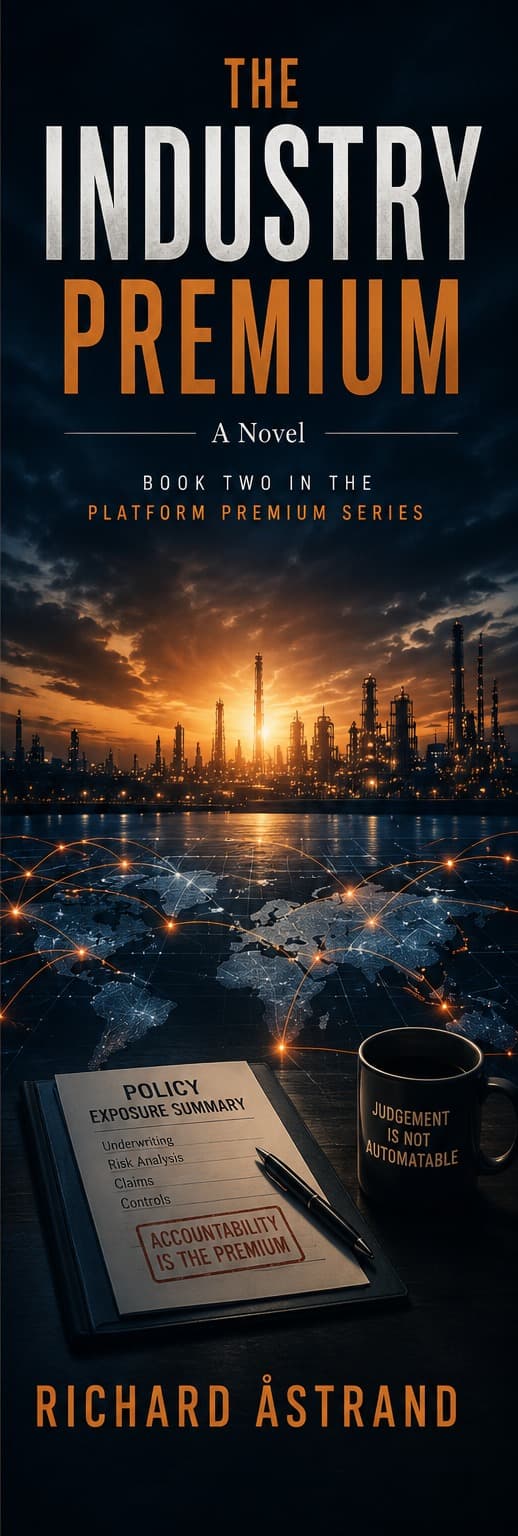
Book Two in the Platform Premium series
The Industry Premium is book two in the premium series. A planned seven book series about digital technology, corporate transformation, private equity and power dynamics.
The Platform Premium asked what digital transformation should actually create. The Industry Premium asks what happens when transformation reaches a regulated, capital-intensive, trust-based industry where the product is not software, freight, or process speed. The product is confidence.
NorthBridge created value by making institutional judgement transferable. Meridian faces the harder question: can institutional judgement be made accountable before AI accelerates the not-knowing?
- Book One
The Platform Premium
Visit The Platform Premium - Book Two
The Industry Premium
You're reading about this one
- Book Three
The Board Premium
Visit The Board Premium - Book Four
The Startup Premium
Planned
- Book Five
The Accelerator Premium
Planned
- Book Six
The Cyber Premium
Planned
- Book Seven
The Security Premium
Planned
The story
A claim becomes a rescue. A favour becomes a company.
A plant burns in La Porte. A board member asks Jack Brennan for a favour. At first, the question seems narrow: is Calder facing a hard negotiation, a stalling tactic, or an insurer in trouble? Within days, Jack sees a larger pattern. Meridian Specialty Assurance is not one company. It is more than twenty acquired insurers, underwriters, claims teams, data systems, and cultures wearing one logo. It has sold certainty without building the plumbing to understand the promises underneath.
The claim becomes a balance-sheet crisis. The balance-sheet crisis becomes a technology crisis. The technology crisis becomes a leadership crisis. And the central question is no longer whether Meridian should pay. It is whether it can survive becoming the kind of company that pays when the promise is real.
AI can consolidate a risk calculation. It cannot consolidate trust.
The first is arithmetic. The second is a promise between people. Meridian's owners want intelligence to solve an integration problem. But intelligence applied too early does not create truth. It amplifies the company's existing definitions, contradictions, and incentives. A model cannot tell the difference between a customer who lied and a company that never reconciled its own systems unless the company has first done the human work of agreeing what the facts mean.
Who should read it
Read The Industry Premium if you are responsible for transformation in a serious industry, investing in businesses whose value depends on trust, governing companies under operational pressure, or trying to understand why AI makes institutional discipline more important, not less.
- Executives
- A story about accountability when systems, customers, and capital collide.
- Investors
- A roll-up cautionary tale about scale without integration.
- Technologists
- A practical warning about applying intelligence before truth exists.
- Insurance and risk leaders
- A serious exploration of claims, reserves, reinsurance, ratings, brokers, and trust.
- Board members
- A governance fable about what must be known before a promise can be kept.
Six ideas at the center of the book
- 01
The promise is the product
Insurance is not only capital allocation. It is a public promise that someone will stand behind a future loss.
- 02
Scale can hide fragmentation
A roll-up can become one logo and one balance sheet without becoming one institution.
- 03
AI amplifies institutional truth
If definitions conflict upstream, the model produces confident nonsense downstream.
- 04
Risk is networked
A single industrial event can touch suppliers, customers, warehouses, logistics providers, and insurers at once.
- 05
Human judgement must be explainable
The company must explain why it said yes, why it said no, and who was responsible when reality disagreed.
- 06
Capital buys time, not trust
A rescue can stabilize the balance sheet. It cannot, by itself, rebuild the promise.
The opening
Read the first pages
Prologue
The Light in the Distance
The closing bell had rung six hours earlier, and the thirty-ninth floor had begun the small, well-rehearsed ceremony of pretending nobody had doubted it would.
Jack Brennan had led the private-equity sponsorship behind NorthBridge's transformation. Mary Voss, its chief executive, had done the harder work: turning capital, technology and accumulated judgment into a company that could operate without him.
Houston lay under the windows in its evening arrangement—the freeways thickening into rivers of light, the ship channel a black seam stitched with sodium lamps, and beyond it the refineries breathing their patient blue flares. On the muted television above the bar, NorthBridge Logistics Group's ticker kept moving through the financial news crawl as if the company had always belonged there. At nine-thirty that morning Mary Voss had stood beside Jack Brennan at the exchange, one hand on the bell rope and the other briefly closed around his wrist while the room counted down. At four, the stock had finished its first day above the offer price. The underwriters called it disciplined. The bankers called it a successful debut. Everyone in the room called it proof.
The practical effect was simpler than the language around it. Platinum Eagle had sold enough shares in the offering to return the capital invested in NorthBridge and materially strengthen distributions across the firm. Every dollar still held in NorthBridge—and a great many dollars remained—was now upside. The earlier fund no longer carried the same burden of having to justify the investment, and Fund V's fundraising story now rested on realized proof rather than projection. NorthBridge had not been sold. It had become public, which was a different kind of ownership and, Jack suspected, a more demanding kind of audience. He kept his board seat. Mary remained chief executive. The company would still call when the question was real. It would simply stop calling every Tuesday because Jack had made the calendar say so.
That was the reward Marcus Reeves had described to the investment committee: liquidity without departure, validation without surrender, and enough room in Jack's schedule to find the next NorthBridge before the market named it for him. Standing in the reflected city, Jack understood the room in his calendar as clean acreage. Everyone else seemed to regard acreage as freedom. Jack had spent thirty years turning empty space into obligation before it could frighten him.
Marcus crossed the floor carrying two glasses and a book thick enough to stop a door. He put the water in Jack's hand and the book against Jack's ribs. The cover was a photograph of Warren Buffett looking mildly inconvenienced by having become Warren Buffett. "Sandra's idea," Marcus said. "Mine was a watch."
The private room had too much mahogany and, for the first hour, ran on the fuel every post-IPO dinner runs on: relief wearing the clothes of certainty. Mary Voss—NorthBridge's chief executive, who had taken a forty-year logistics company through a covenant winter, a platform build, three acquisitions and a public-company roadshow without ever confusing endurance with a strategy—was three seats down telling the story of the last investor rehearsal. A portfolio manager had asked whether NorthBridge's advantage could survive her departure. Mary had looked at him and said, "That is the product." The table laughed in the right places. They had all heard it twice. It improved because the answer remained true.
Jack set down the book and waited for the room to settle, which took longer than it should have, because a room that has just been priced by the public market is reluctant to stop hearing itself.
"I have spent most of my career," he said, "learning that companies are almost never bought for what they first appear to be. Today NorthBridge was not bought by one person. It was bought in fragments by thousands of people who will never stand on the operations floor, meet a carrier or watch Ryan Decker decide which red dot matters. The assets matter. The contracts matter. The technology matters. But in the companies worth owning there is something underneath all of it—accumulated judgment. The thousand small things an organization knows because it has solved the same hard problem a thousand times, under pressure, with a customer waiting and the information incomplete."
A few heads nodded. This was safe ground. It was also true ground, which in his experience was rarer.
"Three years ago NorthBridge did not know what it knew. It had good people quietly compensating for weak systems, and complexity that everyone had agreed to call sophistication because the alternative was admitting how much of the company lived in four or five heads. Mary and the team did not make that judgment less human. They made it transferable. They gave the company a way to remember, test, improve and act without waiting for the one person who had seen the problem before. The market placed a price on that today. The team created it long before the bell."
He looked first at Mary, then at the NorthBridge people distributed among bankers who had learned their names only during the roadshow.
"To the public shareholders, I would say this if any of them were foolish enough to take free advice from a private-equity investor: you paid for the company as it stands. Watch what it might still become. And to the people who built it: the ticker is not the company. Do not let anyone with a screen persuade you otherwise."
The room laughed lightly at the first sentence and went quieter at the second. Jack watched Mary receive the words without thanking him for them. That was one of the reasons she had been the right chief executive.
Mary found him afterward near the coffee, jacket over one arm, the other hand holding a pair of heels she had abandoned sometime after the photographs.
"You know what I will not miss?" she said. "Your Tuesday calls. Three years, and you never once opened with the number."
"The number was never the interesting part."
"Says the man whose fund is now covered before the lockup expires." She looked at the Buffett biography Marcus had left beside him. A card protruded from the first chapter. "What did they write?"
Jack pulled out the card. In Marcus's square hand: THE ONLY INSPIRATION LEFT TO BEAT. "Apparently I have homework." Mary put out her hand. "Take the win, Jack. Then find something difficult enough that you stop hovering over mine." He shook her hand. "That is the plan." "That," she said, "is what worries me."
Later, when the room had thinned to bankers and the durable, he stood at the glass with a tumbler of water he was not drinking and the Buffett book under his arm. NorthBridge's invested capital returned. The retained NorthBridge stake. The carry that existed on paper and would not exist in cash until the lockup and the market had both finished having opinions. The sources and uses settled in his head with the quiet mechanical click of accounts closing. The number was large enough to change the language other people used around him. He waited for it to change something inside him. What arrived instead was a list of work no longer requiring his presence.
Then, past the channel, the dark did something dark is not supposed to do.
It began as a smear of orange low on the horizon, where the industrial flats ran to the water. It was the wrong color for a flare, which burns blue and clean, and it had no stable shape—only a spreading warmth beneath the clouds, as if someone had held a match too close to the city's belly.
"Refinery," said a banker beside him, without much interest, already looking back at his phone. "They flare off at night. Looks worse than it is."
But it was not a flare, and Jack watched it the way he watched anything that was behaving unlike itself, which was the only thing he had ever really been good at. The orange deepened. A column began to build above it, blacker than the night it climbed into, catching the underlight of the ruined-orange glow so that for a moment the whole eastern sky looked bruised. Far below, along the freeway, the first sirens detached themselves from the ordinary river of red taillights and began to move against the current.
The party did not stop. Parties do not stop for a light in the distance; that is what distance is for. Someone proposed a toast to Mary and the first day of trading, and the room found its glasses. A woman near the window said, to no one, that the view was really something tonight, and a man agreed that it was, and neither of them meant the fire.
"Some plant out past the channel," offered a NorthBridge director who had wandered over, following Jack's gaze. "Chemical, I think. My brother-in-law does insurance surveys out there—says half those places are one deferred maintenance order from a very bad afternoon." He shrugged, the way people shrug at other people's very bad afternoons, and went to join the toast.
Jack said nothing. He had no reason to attach meaning to it. He noticed the fire because he noticed systems under load, especially when everyone else had agreed the system was behaving normally. He filed it where he filed such things—the way a man files a sound in a car engine he does not own—and turned back toward the room.
His phone buzzed once against the cold glass.
Adrian Liu Fri 21:47
Jack Brennan, IPO millionaire. The whole channel can see NorthBridge's afterparty from space.
Adrian Liu Fri 21:47
Also possibly on fire. One of those.
Jack 21:53
The fire's not us. We only burn money.
Adrian Liu 21:54
Ha. Buy you a bad whiskey this week before you get bored and start buying things you shouldn't?
Jack 21:55
I don't get bored.
Adrian Liu 21:56
That's the part that worries the rest of us.
Jack put the phone away. Behind him the room lifted its glasses to NorthBridge's first day as a public company. On the table beside him, Warren Buffett looked out from the cover of a biography Marcus had labeled the only inspiration left to beat. In front of him, beyond the black seam of the channel, the light in the distance went on doing what it was doing, and would go on doing it for eleven hours, and had a name he did not yet know.
Read The Industry Premium
Choose your edition
Buy The Industry Premium directly from Lulu. Editions will link out as soon as they're published or available for pre-order.
Paperback
Softcover · 6″ × 9″
The standard reading edition, printed on demand.
Coming soonHardcover
Casebound · 6″ × 9″
A durable edition for shelves, offices, and gifting.
Coming soonEbook
Digital edition
Read on your device of choice.
Coming soonThe Platform Premium
Book One in the series
New to the series? Start with the NorthBridge transformation that leads into this story.
Read Book One
Prices and shipping are shown by Lulu and may vary by destination.
Frequently asked questions
- No. The Industry Premium stands alone. Readers of The Platform Premium will recognize Jack Brennan, Mary Voss, NorthBridge, and the strategic arc that leads into this story.
- It is a business thriller built as a fable. The story carries the ideas: AI, insurance, capital, industrial risk, leadership, and accountability.
- Yes, but not in the usual sense. It is about what must be true inside a company before AI can safely accelerate decisions.
- No. Insurance is the arena. The deeper subject is how trust-based companies behave when capital, technology, and real-world consequences arrive at the same time.
- Editions will be linked directly to Lulu on this page as soon as they're available. Follow along on LinkedIn or Substack for launch updates.